1 Executive Summary
We analysed over 20,000 headlines from the BBC, the New York Times, and the Guardian and found systematic, quantifiable patterns of biased framing that dehumanise Palestinians and shield Israel from accountability. These outlets do not fabricate facts. They do something more insidious: they deploy a set of interlocking linguistic techniques that determine how readers process those facts, techniques that operate differently depending on whether the perpetrator is a Western-aligned state or an adversary. The result, across three newsrooms, thousands of headlines, and twenty months of coverage, is that Israeli violence against Palestinians is rendered invisible, uncertain, clinical, and emotionally remote, while comparable Russian violence against Ukrainians is reported with directness, certainty, plain language, and human empathy.
These techniques do not operate in isolation. They compound. A single headline about an Israeli airstrike killing children can simultaneously erase Israel as the agent, hedge a verified event as a contested claim, wrap the killing in clinical jargon, and withhold the humanising framing that would make the reader feel the death as a tragedy. The same outlet, covering the same category of event for Russia, will name the perpetrator, state the killing as fact, describe it in plain language, and centre the victim’s story. This is the same newsroom, making opposite framing choices, for the same category of human suffering.
1.1 What the insights reveal
- 37% of Israel-Palestine headlines erased the perpetrator entirely, nearly twice the rate for Russia-Ukraine coverage (19%)
- The BBC obscured Israeli responsibility in 83% of relevant headlines, the NYT in 65%, and the Guardian in 57%
- When adjusted for protective vs accusatory function, the protection ratio for Israel over Russia ranged from 5x to 15x
- Even when Israel admitted to its own actions, outlets hedged verified events with “reportedly” and “claims,” deploying distancing language at 2.5x the rate of Russia-Ukraine coverage
- Israeli actions received 2-4x more doubt-casting than comparable Russian actions across all three outlets
- 70% of headlines about Israeli actions in the BBC and NYT wrapped bombings in sanitised language like “operations” and “targeted actions,” compared to 2-3% for identical Russian violence
- Ukrainian victims were humanised 77-84% of the time, while Palestinian victims received such humanisation only 52-64% of the time
- Israel, despite being the perpetrator, received nearly identical empathetic framing to the very people it was killing
1.2 Why this matters
People have long suspected that these outlets were biased against Palestinians, and their suspicions have been routinely dismissed as paranoia or exaggeration. This investigation transforms those intuitions into hard, quantifiable evidence across 20,000+ headlines that cannot be waved away.
When a reader encounters “buildings destroyed” rather than “Israel destroys buildings,” accountability evaporates and outrage dissipates. Multiply that by millions of readers across years of coverage, and you arrive at the manufactured apathy that has enabled a genocide to proceed while the world looked the other way. These numbers identify precisely where and how the framing operates, giving regulators, educators, watchdogs, and ordinary readers the tools to fight back.
1.3 Recommendations
For the BBC, NYT, and the Guardian
- Audit headline guidelines for differential application of passive voice, attribution, and euphemistic language across conflicts
- Establish parity standards: if Russia’s actions warrant direct language, so do Israel’s
- Publish transparency reports on editorial language choices in conflict coverage
For media regulators and press standards bodies
- Incorporate linguistic bias metrics into regulatory frameworks
- Commission periodic computational audits of conflict coverage
- Develop enforceable guidelines addressing the systematic manipulation of reader perception through framing
For civil society and media watchdog organisations
- Conduct ongoing, real-time monitoring using this study’s methodological framework
- Build public-facing dashboards making bias metrics accessible to general audiences
- Advocate for media literacy curricula that teach identification of agent deletion, distancing, and sanitising framing
2 Background
One of the most horrid events to blot the collective consciousness of humanity in recent times is the genocide of Palestinians in Gaza. Massacres upon massacres were streamed live, and repeatedly shown, only for people to shrug off and move about their lives as if Palestinians did not matter.
One of the vehicles enabling this apathy has been propaganda at mass scale, particularly when masqueraded as objective news reporting by a majority of Western news outlets.
This investigation seeks to expose how some of these news outlets have sought to manufacture mass apathy, focusing explicitly on headlines as they are the first point of contact between a reader and hidden propaganda. Our study confirms that it is these headlines that are riddled with propaganda and anti-Palestinian biases.
The investigation was initiated based on ‘early signals’ received from experts in journalism and Palestinian history, who were already identifying instances of biased headlines leading to the dehumanisation of Palestinians.
In the upcoming sections, we show how the Western media used not just passive tense but a host of other techniques to absolve Israel of any responsibility in the massacre of Palestinians.
3 Methodology
3.1 Analysis
Our analysis tackles two fundamental questions at the heart of bias exposure:
- What type of coverage is given to the Palestinian genocide?
| Coverage Type | Characteristics |
|---|---|
| (1) Fighting / War related | Military operations, battles, attacks, weapons use, combat casualties, territorial gains/losses, escalation threats |
| (2) Human cost and tragedy | Civilian suffering, refugees, displacement, personal loss, health crises, aid needs, trauma, hostages |
| (3) Ripple effects on nearby regions | Economic sanctions, trade impacts, regional stability, social change, environmental and cultural effects |
| (4) Diplomacy and politics | Peace talks, diplomacy, leader statements, UN actions, alliances, political decisions, legal accountability |
- For the coverage in question, are the headlines biased? If so, what linguistic manipulation is used to steer readers towards a particular narrative?
| Category | Sub-type | Definition | Example |
|---|---|---|---|
| Agency Obscuration | (1) Agent deletion | Omitting who performed an action, making events appear spontaneous without human agency | “Bombs fell on residential areas” vs “Israeli forces bombed residential areas” |
| Agency Obscuration | (2) Passive voice | Grammatical structure demoting or omitting the actor responsible for an action | “50 civilians were killed in airstrikes” vs “Israeli airstrikes killed 50 civilians” |
| Agency Obscuration | (3) Nominalisation | Converting action verbs to abstract nouns (e.g., “destruction” vs “X destroyed”), hiding actors | “Destruction of Gaza neighbourhood continues” vs “Israeli forces continue destroying Gaza neighbourhood” |
| Doubt Amplification | (4) Distancing language | Using qualifiers, scare quotes, or hedges to create doubt about verified events | “Israeli forces accused of ‘massacre’” vs “Israeli forces conduct massacre” |
| Emotional Dampening | (5) Sanitising language | Clinical/technical terminology that masks the violent or harmful nature of events | “Military neutralises 15 targets in precision operation” vs “Military kills 15 people in bombing raid” |
| False Equivalence | (6) False equivalence | Implying equal responsibility between parties with significant power imbalances | “Violence erupts between protesters and police” vs “Police clash with protesters” |
| Empathetic Narrative | (7) Empathetic narrative framing | Foregrounding individual stories over systemic perspectives to drive emotional engagement | “Refugee father carries sleeping child 15 miles to border” vs “Refugees travel long distances on foot to reach border” |
A key part of our methodology is that we compare coverage and biases detected in the Israel-Palestinian conflict against the Russia-Ukrainian war. This comparative design is deliberate and requires justification.
3.2 Why benchmark against Russia-Ukraine?
The comparison is not designed to claim the two conflicts are politically identical. It tests a specific null hypothesis: if the linguistic patterns in Israel-Palestine coverage were the product of editorial convention or generic journalistic norms, we would expect broadly similar patterns in Russia-Ukraine coverage. Both conflicts involve:
- Large-scale military operations causing mass civilian casualties
- Documented war crimes and violations of international humanitarian law
- Asymmetric power dynamics (a dominant aggressor and a weaker party bearing civilian harm)
- Extensive humanitarian crises and active legal proceedings (ICJ, UN resolutions)
The same outlets, applying the same editorial standards, produce radically different linguistic outputs depending on the conflict. Israeli responsibility is obscured at 2x the rate of Russian responsibility. Israeli violence is sanitised at 20-35x the rate. Israeli actions receive 2-4x more protective distancing language. Palestinian victims are humanised 15-25 percentage points less than Ukrainian victims.
These are not marginal variations. They are systematic, large-magnitude disparities across all three outlets, all bias categories, and the entire twenty-month observation period. If anything, Palestinians, a stateless and occupied population, should receive more careful attribution and humanisation. The data show the precise opposite.
The Russia-Ukraine benchmark serves as a control condition isolating the variable of geopolitical alignment. It demonstrates that Western outlets are capable of direct, accountability-centred reporting, and that they systematically choose not to apply it when the perpetrator is a Western-aligned state.
3.3 Data
We extracted data from the following major Western news outlets:
- The NYT
- The BBC
- The Guardian
From each, we extracted data from Oct 2023 until May 2025, and filtered for headlines that pertained to either Israel-Palestine or Russia-Ukraine war, eventually ending with 20,000+ headlines.
3.4 Scope: Why headlines
Most readers never get past the headline, and on social media the headline is often all they see. This analysis focuses on headlines categorised under “The Human Cost,” accounting for 36% of Israel-Palestine coverage. Analysis of remaining clusters is forthcoming.
3.5 Sample headlines and analysis
| Headline | Coverage Type | Deframe AI Bias/Framing Assessment | Deframed Headline |
|---|---|---|---|
| “Aid to Gaza falls to lowest level in 11 months despite US ultimatum to Israel” | The Human Cost | 🚨 Agent deletion | Israel Restricts Aid to Gaza to Lowest Level in 11 Months Despite US Ultimatum |
| “Israeli Strike Kills Over 20, Including Children, Gaza Officials Say” | The Human Cost | 🚨 Distancing language | Israeli Bombing Kills Over 20, Including Children, in Gaza |
| “Back-to-Back Israeli Strikes Show Tragic Gaps in Choosing Targets” | The Human Cost | 🚨 Distancing language 🚨 Sanitising Language |
Israel Repeatedly Bombs Civilians, Exposing Failures to Distinguish Combatants from Non-Combatants |
| “After Strike, Aid Groups in Gaza Are More Fearful Than Ever” | The Human Cost | 🚨 Sanitising Language 🚨 Agent deletion |
After Israeli Strike, Aid Groups in Gaza Are More Fearful Than Ever |
| “The Israeli hostage whose body was returned Saturday had spoken of feeling unsafe.” | The Human Cost | ✅ Empathetic Narrative | The Israeli hostage whose body was returned Saturday had spoken of feeling unsafe |
4 Understanding coverage of the conflicts
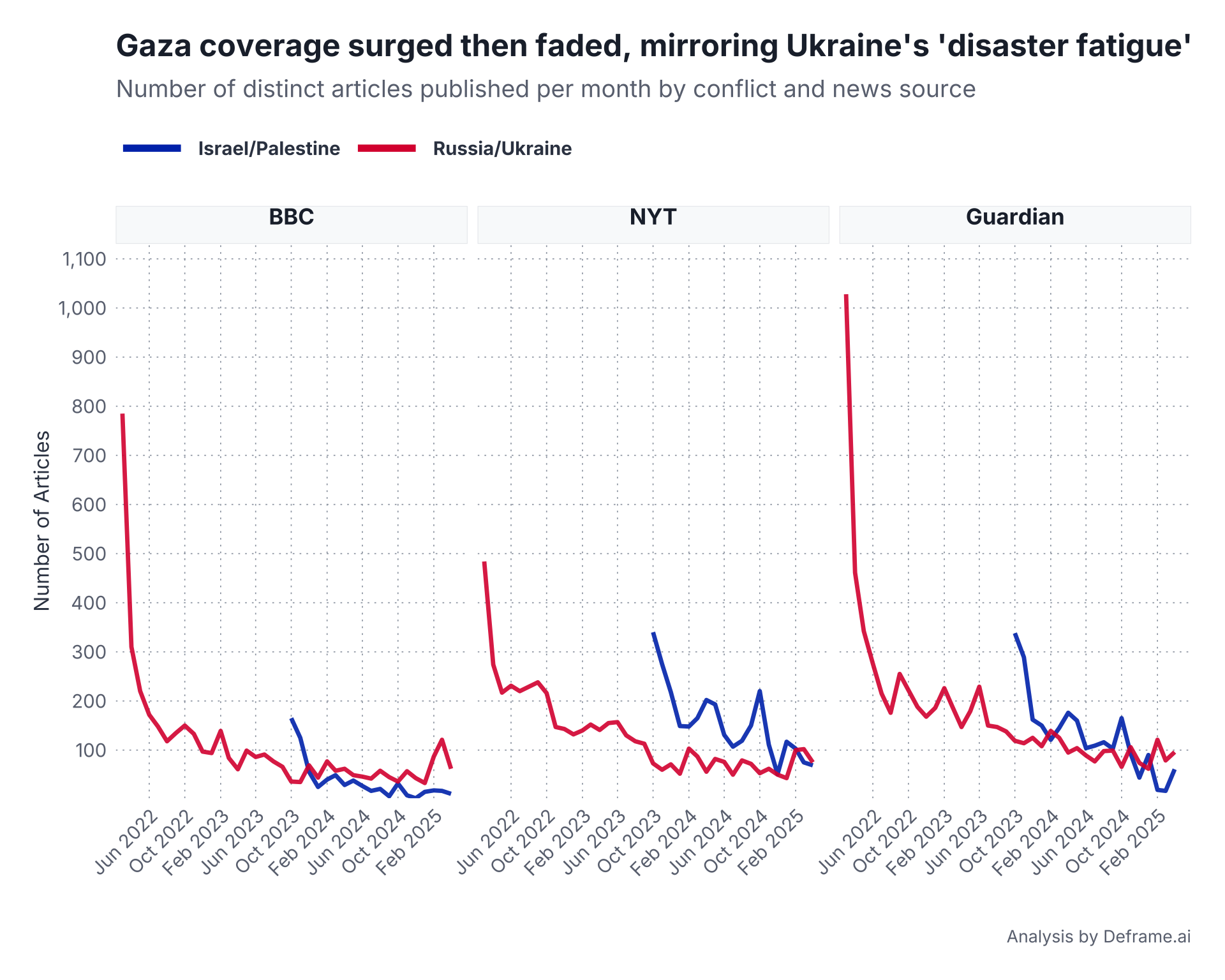
- Both conflicts undergo a ‘disaster fatigue’ stage - outlets report heavily on a conflict at its outset. However, as time passes, reporting gets lesser in quantity until stabilising or vanishing.
- The Guardian prioritized Russia-Ukraine most heavily (1,000+ articles/month initially), while the NYT showed the sharpest Israel-Palestine pivot (340+ articles October 2023). BBC displayed weakest intensity for both conflicts.
- Note: Whilst Israel/Palestine was being covered before Oct 2023 with low intensity, the focus of this research is on coverage given from 7th Oct 2023 onwards.
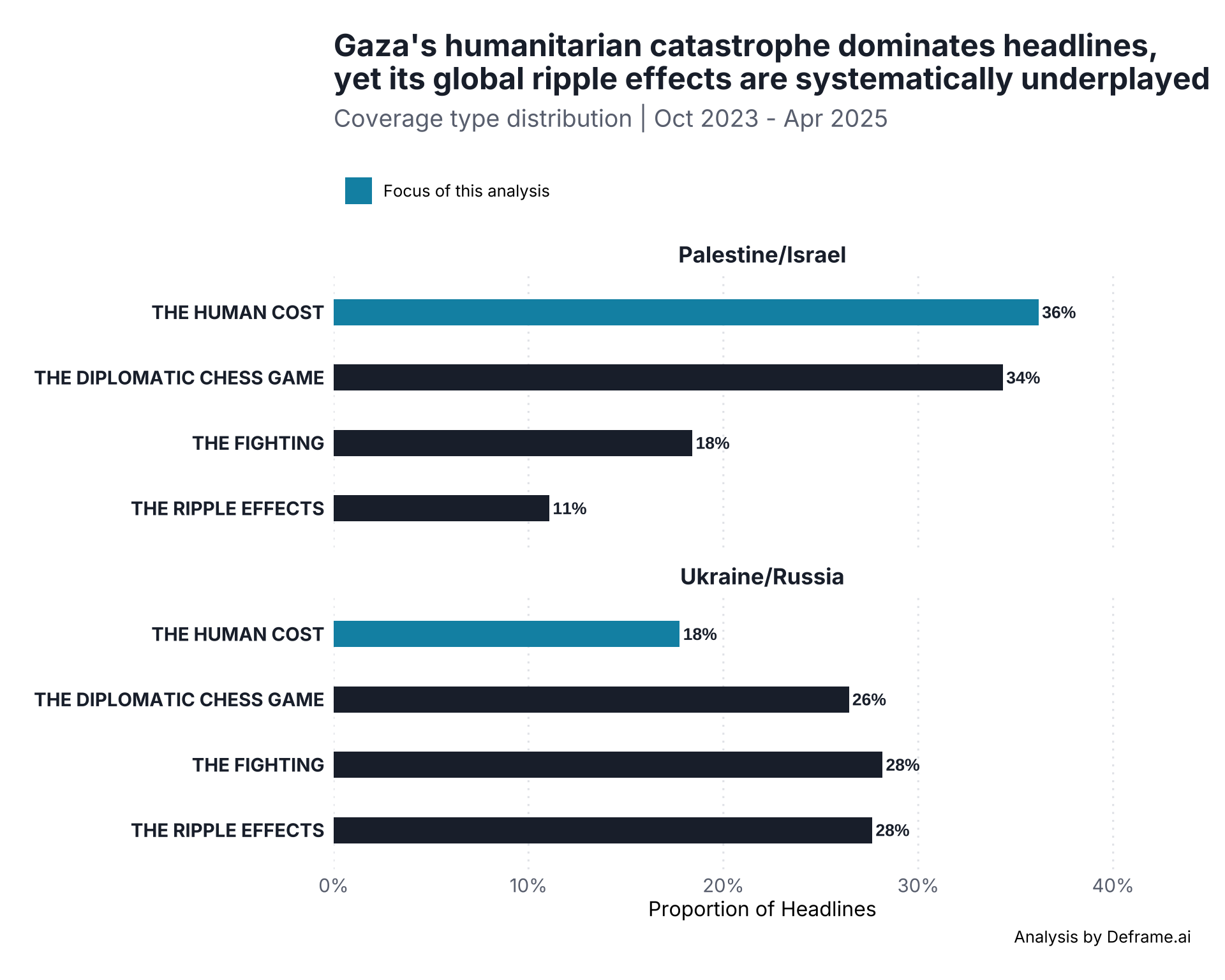
- Gaza coverage prioritizes humanitarian suffering — 36% of headlines pertain to documentation of ‘Human cost’ (civilian casualties, displacement, hostages) against 18% for Ukraine.
- Procedural diplomacy dominates Israel/Palestine framing. Despite peace breakthroughs, ‘Diplomatic Chess Game’ comprises 34% of coverage (UN resolutions, ceasefire calls, ICJ proceedings) versus 26% for Ukraine, where sanctions and NATO coordination produced tangible alliance shifts.
- Ripple Effects expose editorial blind spots — Gaza’s global repercussions register merely 11% against Ukraine’s 28%, showing outlets under-play consequences of Israel’s war on Palestine, treating it as a more ‘localised’ genocide.
5 The Human Cost
We first focus on the Human cost coverage of the Palestinian genocide and compare the same coverage to Russia/Ukraine war.
5.1 Responsibility obscuration: Absolving an agent from responsibility
Agent deletion occurs when headlines omit the responsible actor or use passive voice, presenting violence as though it occurred spontaneously. For example, “buildings destroyed in overnight shelling” rather than “Israeli forces destroy buildings.”
The technique mirrors a pattern well-documented in domestic violence discourse: “woman beaten” structurally performs the same erasure as “neighbourhood levelled.” In both cases, removing the agent from the sentence removes accountability from the reader’s cognitive frame.
When applied selectively — erasing some actors while naming others — it functions not as neutral editorial economy but as a systematic mechanism for distributing responsibility unevenly.
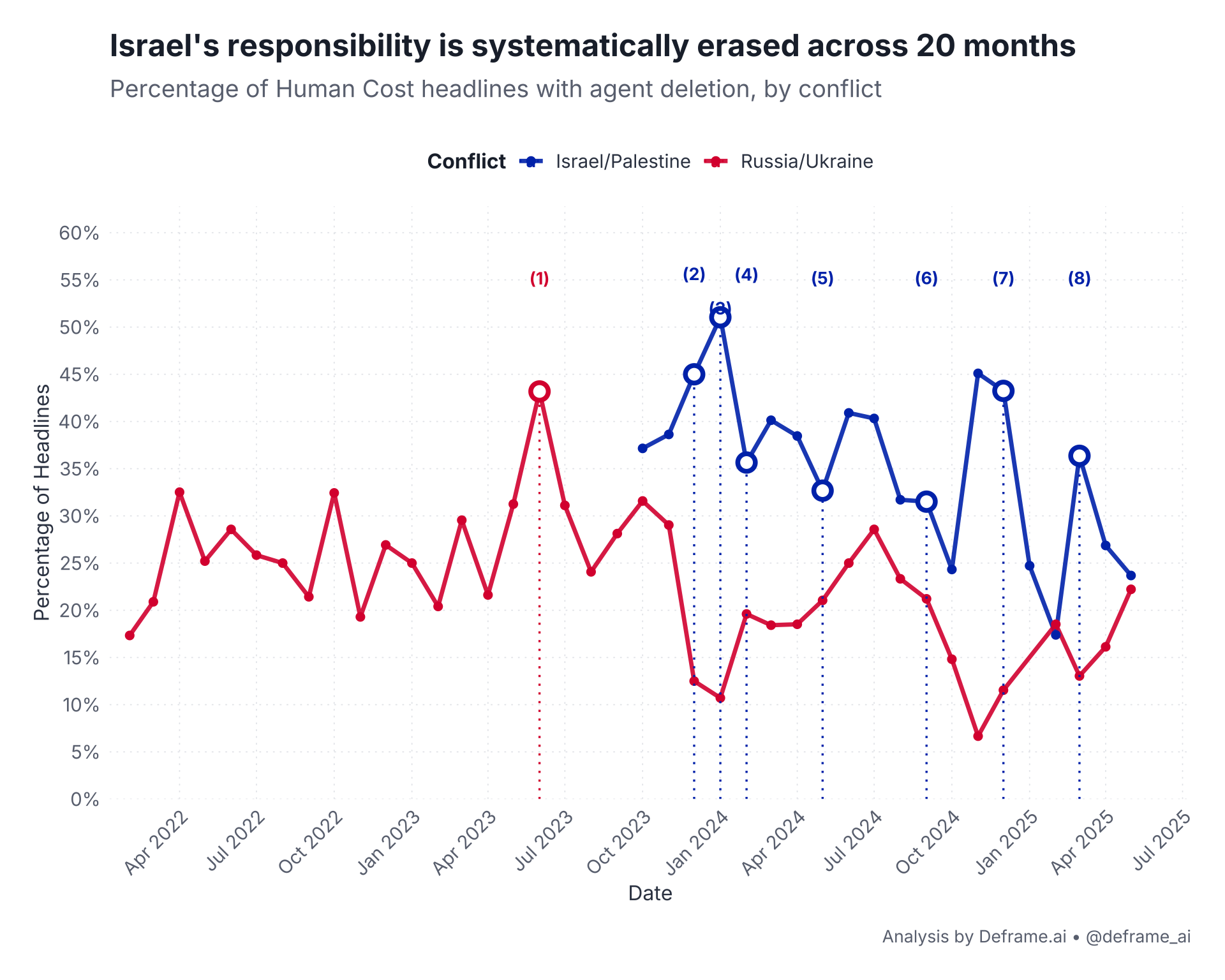
- Kakhovka Dam destruction causes massive flooding and displacement
- Intensified Israeli bombardment of Khan Younis and southern Gaza
- South Africa files genocide case at ICJ; Israel escalates Gaza attacks
- Israel’s flour massacre; 112 Palestinians killed waiting for aid in Gaza City
- Rafah offensive begins despite international opposition
- Israel intensifies attacks in West Bank and continues Gaza operations
- Renewed Israeli military killings before ceasefire negotiations
- Ceasefire collapses; Israeli killings resume in Gaza
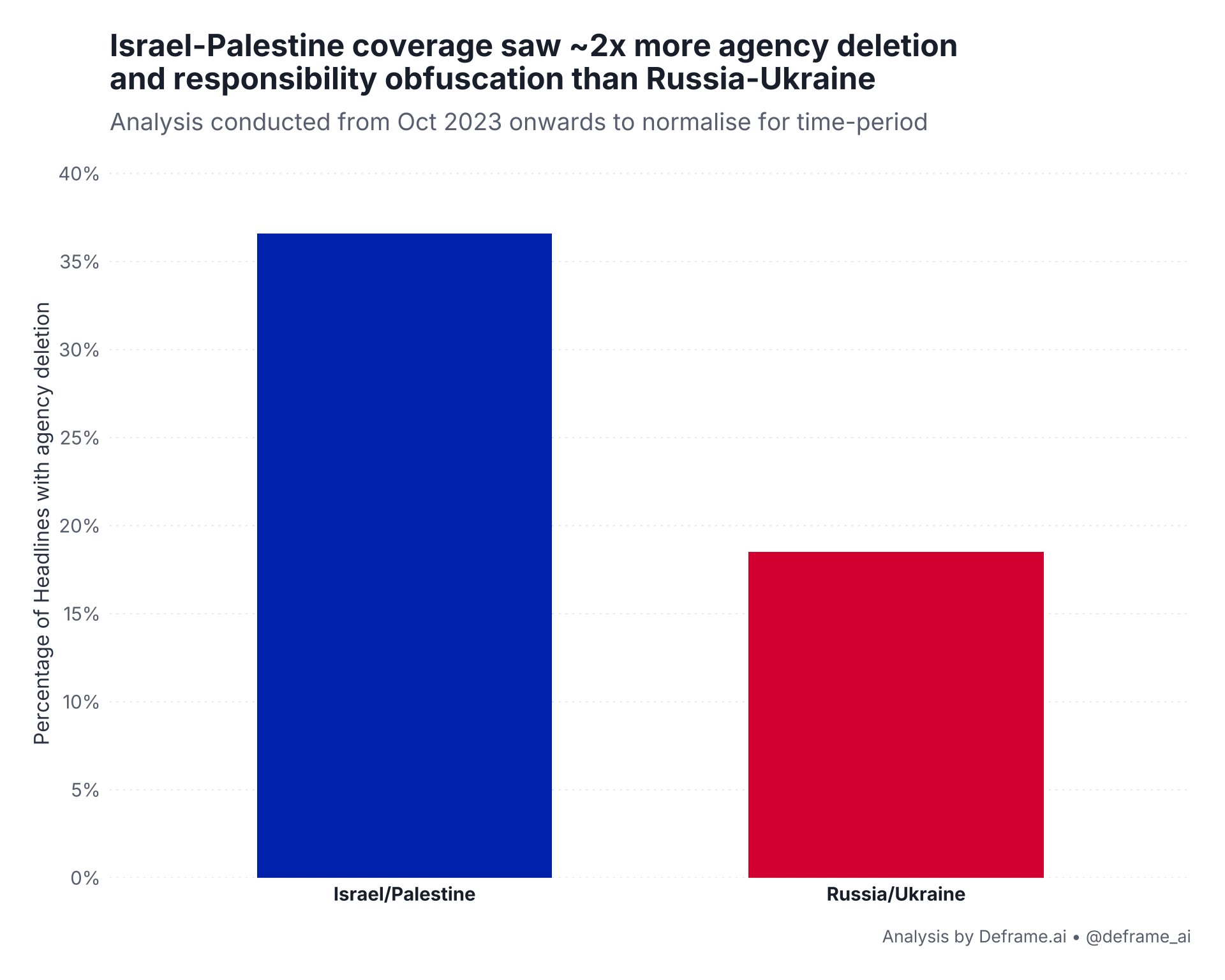
- 37% of headlines covering Israel-Palestine conflict had agency deletion, vs. 19% covering Russia-Ukraine war
- As such, headlines on Israel-Palestine were ~2x more likely to undergo agent deletion
To quantify which actors receive linguistic protection through responsibility obscuration, we calculated the proportion of headlines employing agent deletion when covering each actor’s actions:
\[R_{\text{obscuration}}(A) = \frac{|H_A^{\text{deleted}}|}{|H_A^{\text{deleted}}| + |H_A^{\text{clear}}|} \times 100\%\]
Where \(A\) = actor (Israel, Russia, Palestine, Ukraine), \(H_A^{\text{deleted}}\) = headlines covering actor \(A\) with agent deletion, and \(H_A^{\text{clear}}\) = headlines with clear attribution.
This metric reveals how systematically an outlet obscures responsibility for an actor’s infliction of human suffering, independent of coverage volume.
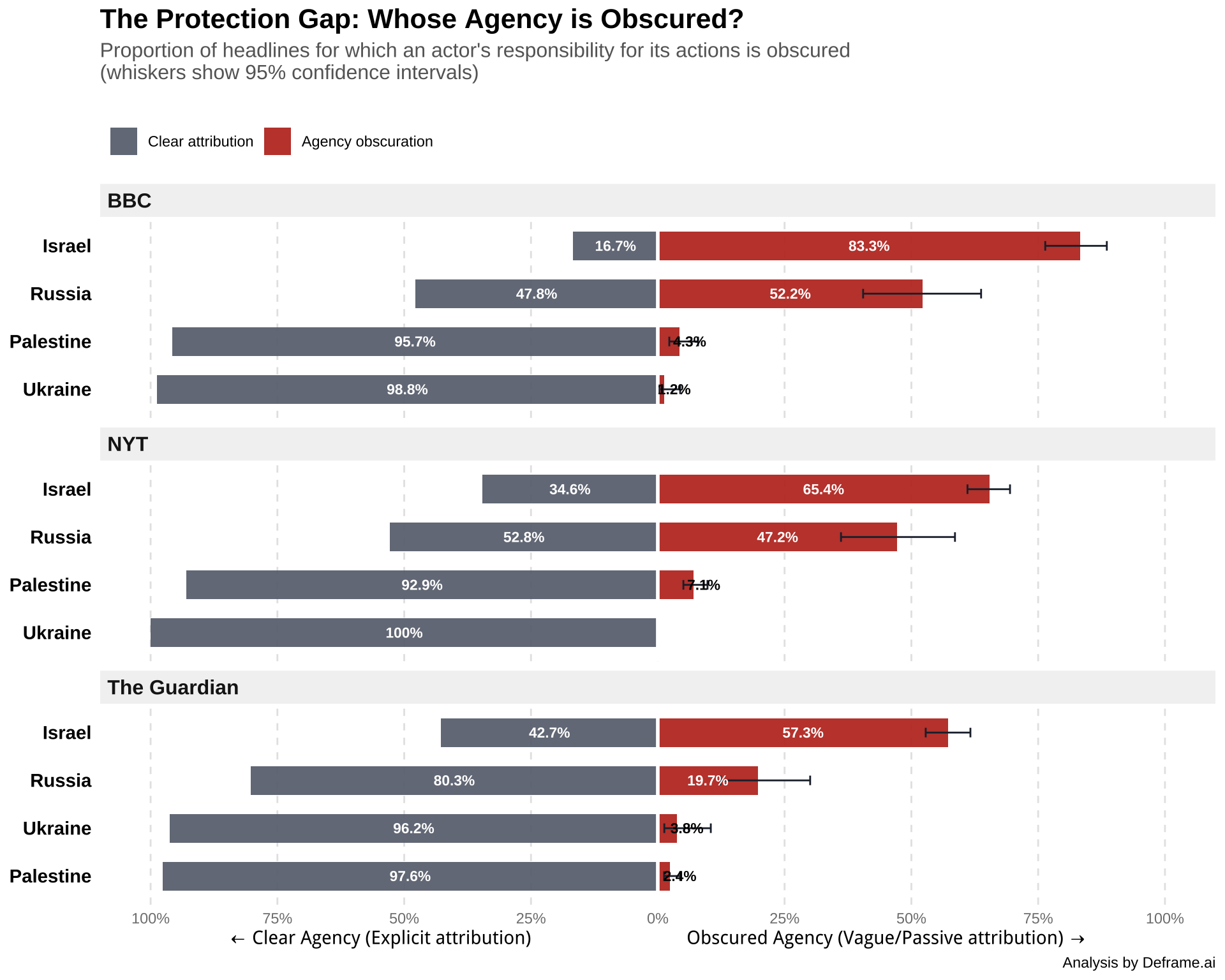
All three outlets systematically protected Israel from accountability for actions causing casualties in Gaza:
- BBC: 83% of Israeli action headlines used agent obscuration (4 in 5 headlines)
- NYT: 65% employed responsibility-obscuring language (3 in 5 headlines)
- Guardian: 57% obscured Israeli responsibility (3 in 5 headlines)
- This trend reverses for Palestine and Ukraine - news outlets directly assign blame to Palestinians, while for Ukrainians their attacks are celebrated
- Interestingly, 52% and 47% of headlines from the BBC and the NYT on Russia also hid blame from Russia. More on this below.
Russia presents a paradox: High obscuration has an opposite function:
- The psychological impact of using agency obscuration in a conflict wherein the perpetrator is well known is not to deflect blame. Instead, it serves to belittle the agent without any possibility of obscuring its responsibility
- In addition, a deeper inspection of these headlines (where Russia’s agency is obscured) reveals that agency deletion centers Ukrainian victimhood and suffering, creating accusatory absence that implies Russian guilt through humanitarian framing
- In contrast, for Israel, agency deletion obscures accountability and prevents clear attribution, creating protective absence that shields from responsibility
A sample of the headlines displaying this phenomenon is presented below.
If we exclude such headlines where agency deletion is not to obscure agency but simply to centre Ukrainian suffering, an even starker picture emerges. We quantify this using the Protection Ratio:
\[\rho_{\text{protection}} = \frac{R_{\text{obscuration}}(\text{Israel})}{R_{\text{obscuration}}(\text{Russia})}\]
The Guardian proves this is editorial choice: only 19.7% Russian obscuration vs 80.3% clear attribution. When outlets choose directness, they can achieve it. Israel’s 57-83% obscuration rates are therefore deliberate framing decisions.
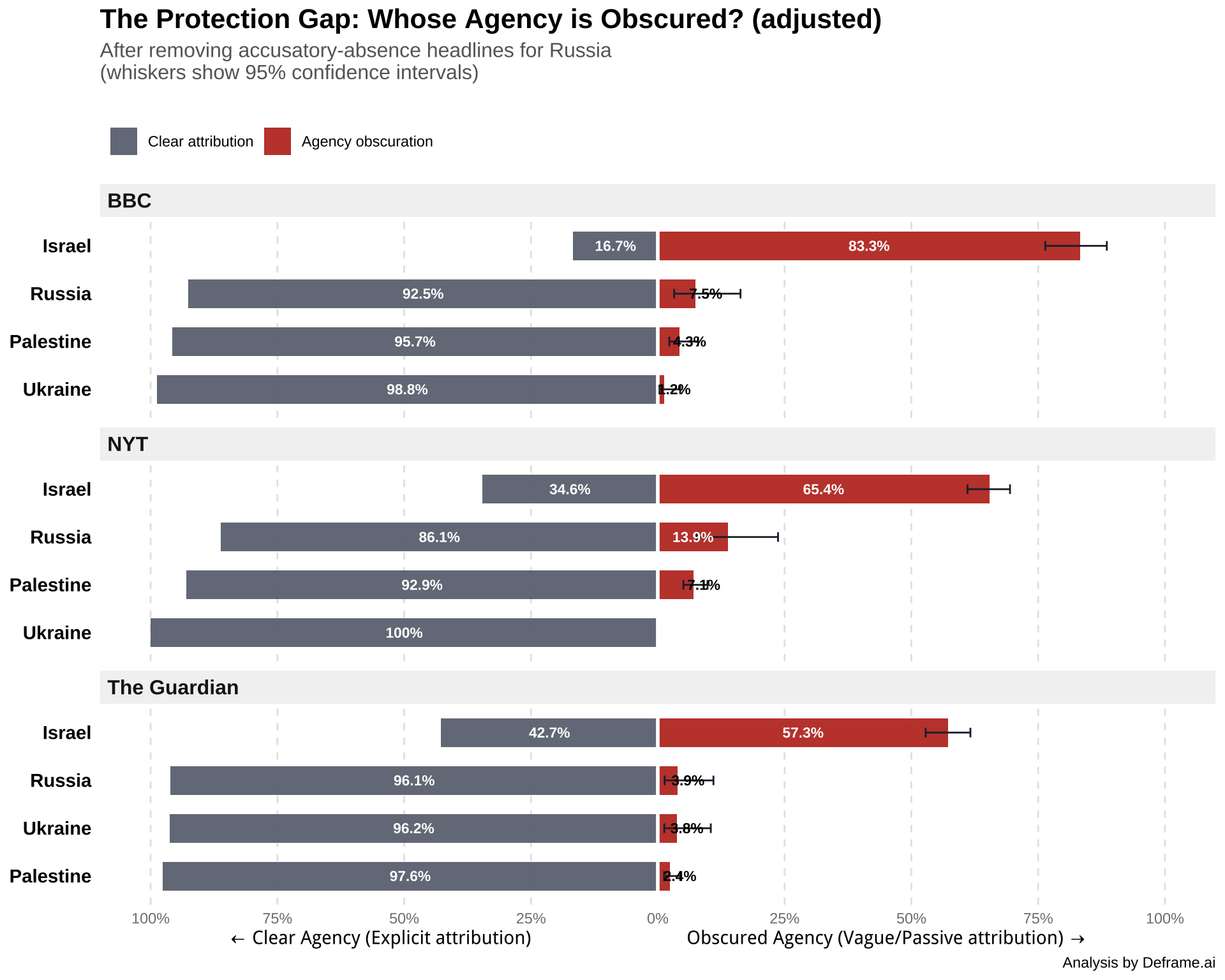
- BBC: 11x more obscuration for Israel compared to Russia (83.3% vs 52.2%)
- NYT: 4.7x more obscuration for Israel (65.4% vs 13.9%)
- Guardian: 14.6x more obscuration for Israel (57.3% vs 3.9%)
- When adjusted for protective vs accusatory obscuration, Israel receives an estimated 5-15x more protective obscuration than Russia
💡 Key Takeaway
These findings demonstrate that agent deletion rates vary systematically based on geopolitical alignment, with the same linguistic technique serving opposite political functions: protection for allies through responsibility obscuration, vilification for adversaries through victim-centered accusatory absence.
The protection gap is quantifiable, consistent across outlets, and represents editorial choice rather than structural necessity.
5.2 Distancing language: Sowing doubts about verified events
Distancing language is used to create artificial doubt into reporting on verified events/ actions of an agent, to ultimately soften the agent’s role. This is done through attribution markers (“says,” “claims,” “reportedly”), modal hedging (“may have,” “apparently”), scare quotes around factual descriptions, and euphemistic substitutions.
The distinction between “Israel bombs hospital” and “Israel says strikes reportedly hit hospital” is not one of journalistic caution but of a structural transformation of fact into contested claim. The mechanism operates even against the strongest possible evidence: when an agent admits wrongdoing — the highest verification status any claim can achieve — distancing language can still intervene to reframe the admission as uncertain narrative.
Applied selectively, this doubt-casting functions not as a reflection of genuine epistemic uncertainty but as an editorial protection mechanism, determining which agents face direct accountability in print and which are cushioned by layers of hedging.
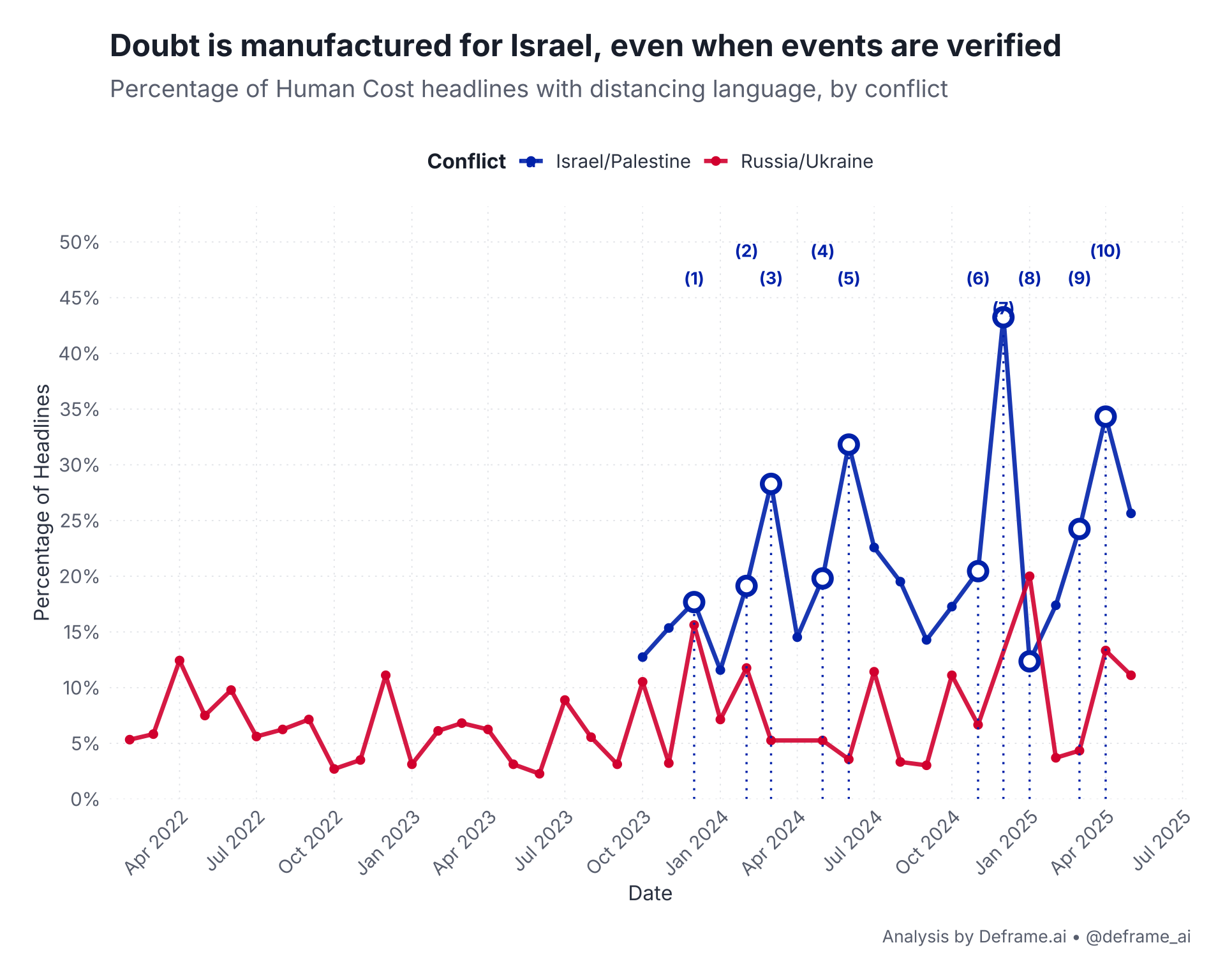
- Intensified bombardment of Khan Younis and southern Gaza
- Israel kills 112 Palestinians in the Flour Massacre; Rafah invasion preparations intensify
- Ramadan ceasefire talks fail; continued bombardment across Gaza
- Rafah offensive begins; Israel seizes Rafah crossing despite ICJ orders
- Continued Rafah operations; humanitarian crisis deepens
- Israel continues ‘multi-front’ attacks; northern Gaza siege intensifies
- Intense bombardment before ceasefire negotiations; Gaza death toll exceeds 45 thousand
- Ceasefire and hostage release deal announced after negotiations
- Ceasefire collapses/major violations; Israeli attacks resume
- Renewed military operations; Israeli tensions with Iran escalate
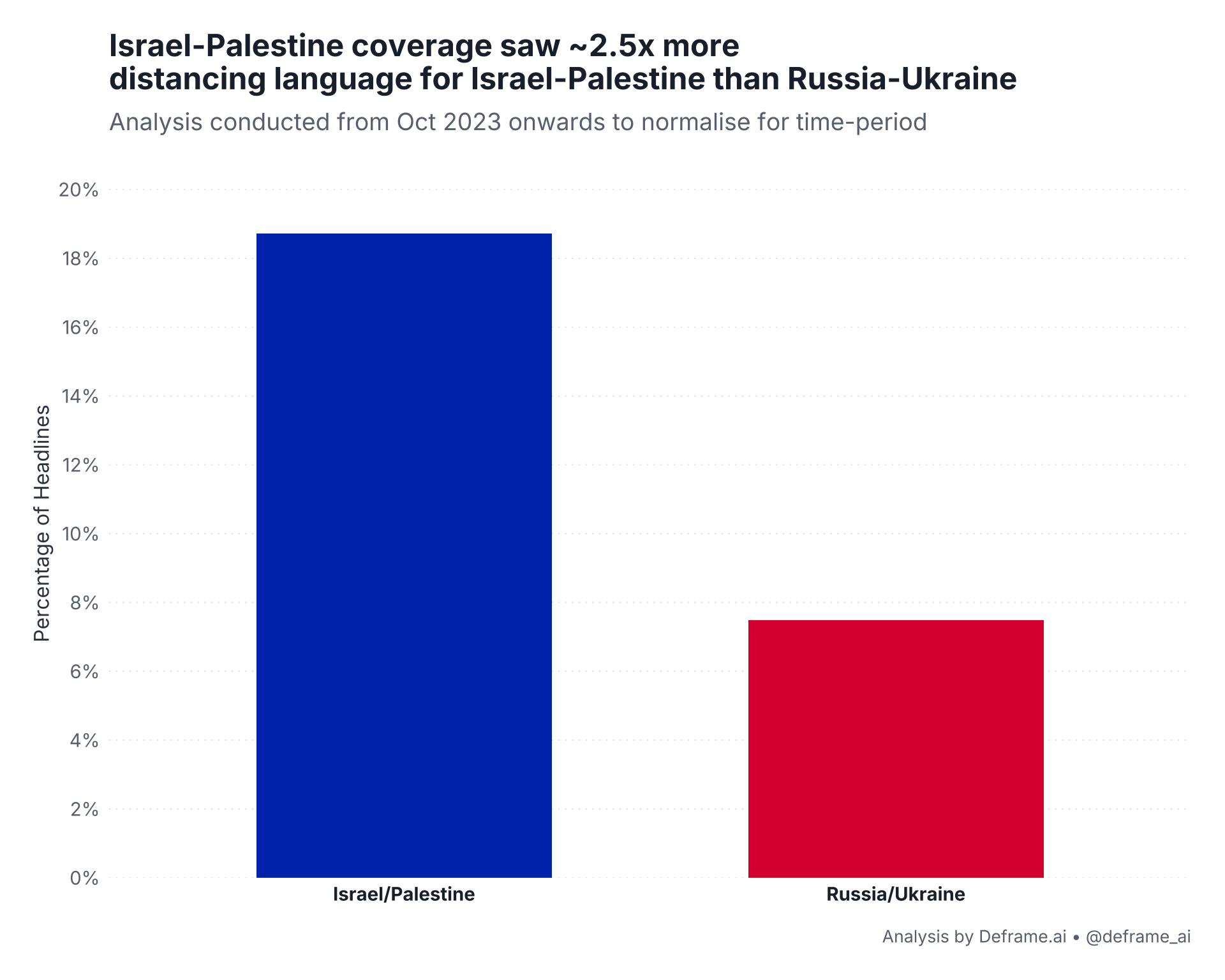
- Approx. 18% of headlines covering Israel-Palestine conflict had distancing language, vs. 7% covering Russia-Ukraine war
- This translates to 2.5x more distancing language being used for covering the Palestinian Genocide
To quantify which agents’ documented actions are artificially cast into doubt, we calculated the proportion of headlines using distancing language for each agent:
\[R_{\text{distancing}}(A) = \frac{|H_A^{\text{distanced}}|}{|H_A^{\text{distanced}}| + |H_A^{\text{direct}}|} \times 100\%\]
Where \(A\) = agent (Israel, Russia, Palestine, Ukraine), \(H_A^{\text{distanced}}\) = headlines covering agent \(A\)’s actions through hedging devices that introduce artificial uncertainty, and \(H_A^{\text{direct}}\) = headlines stating the same agent’s actions as established fact.
This metric reveals how systematically an outlet inserts doubt between an agent and their actions — even when those actions are verified, documented, or self-admitted. A higher distancing rate indicates that an outlet converts factual reporting into hedged narrative, shielding the agent from direct accountability. A lower rate indicates unmediated factual attribution.
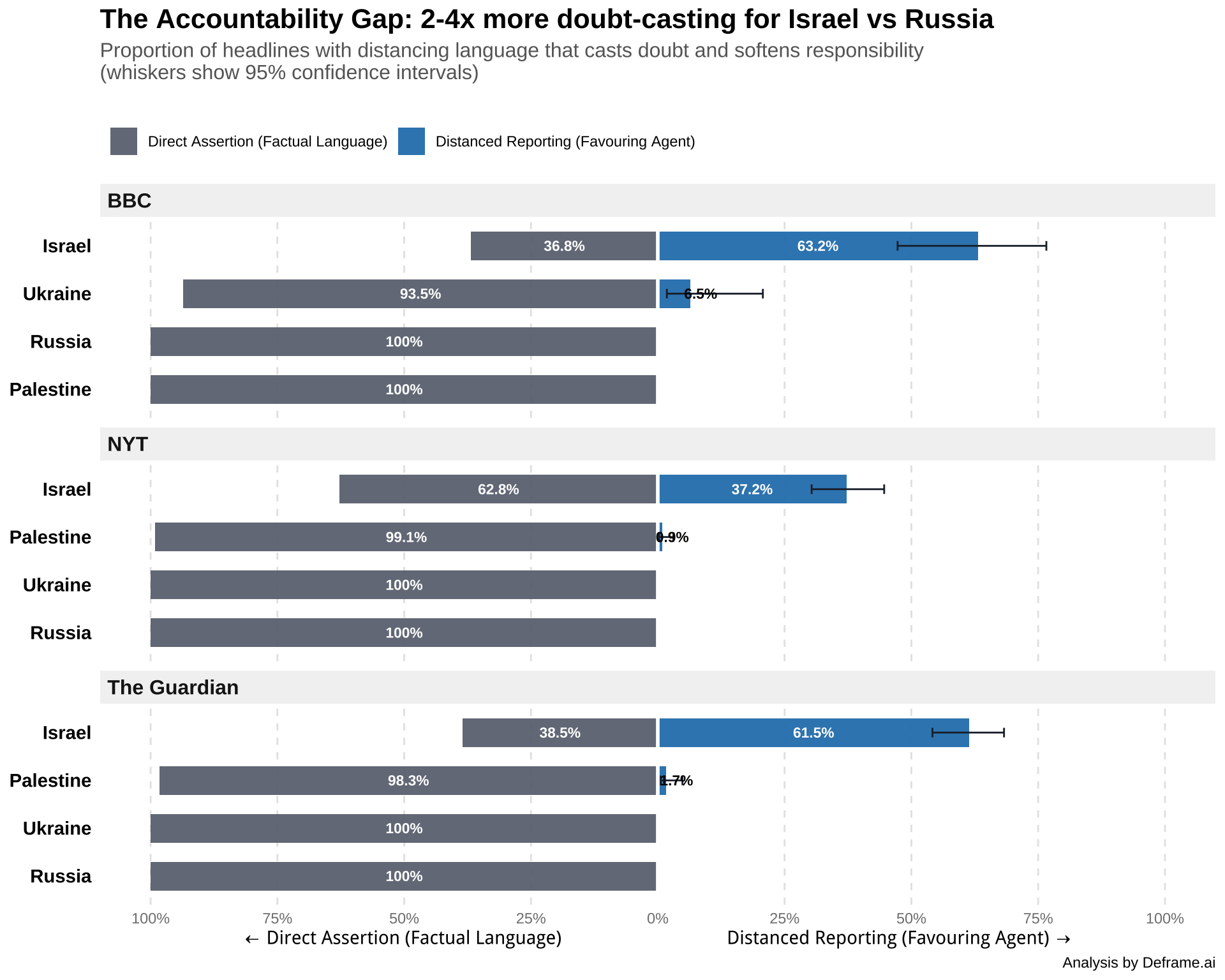
- Across all three outlets, Israeli actions are consistently mediated through distancing language that introduces artificial uncertainty (BBC: 56%; Guardian: 52%; NYT: 30%)
- Between one in two and one in three headlines about Israeli actions are linguistically structured to introduce doubt
- The same outlets report Russian actions with minimal protective distancing (BBC: 24%; NYT: 16%; Guardian: 15%)
- Both Palestine and Ukraine receive virtually no protective distancing across any outlet
The differential application can be quantified as a ratio of distancing rates:
\[\rho_{\text{distancing}} = \frac{R_{\text{distancing}}(\text{Israel})}{R_{\text{distancing}}(\text{Russia})}\]
- Guardian: 3.5x more distancing for Israeli actions (52% vs 15%)
- BBC: 2.3x more distancing for Israeli actions (56% vs 24%)
- NYT: 1.9x more distancing for Israeli actions (30% vs 16%)
Across all three outlets, Israeli actions receive between two and four times more doubt-casting protection than comparable Russian actions.
💡 Key Takeaway
Distancing language reveals itself not as epistemic caution proportionate to genuine uncertainty, but as a selectively deployed editorial mechanism.
When outlets report Russian actions with 85% directness while hedging Israeli actions 52% of the time — including Israel’s own admissions of wrongdoing — the pattern indicates that linguistic distancing operates as a function of geopolitical alignment rather than verification status. The same categories of events that warrant direct factual assertion for one actor receive systematic hedging for another, producing fundamentally asymmetric conditions of accountability across conflicts.
5.3 Sanitising language: Softening the human cost of war and genocide
Sanitising language substitutes clinical, technical, or bureaucratic terminology for direct descriptions of violence — converting killings into “operations,” civilian deaths into “collateral damage,” and systematic targeting failures into “gaps in choosing targets.” The effect is to suppress the moral and emotional register of reporting: events that would provoke immediate outrage when described in plain language become procedural when rendered in sterile jargon.
This creates an asymmetry not in what is reported, but in how it is experienced by the reader — the same act of violence processed through fundamentally different affective frames depending on whose violence it is.
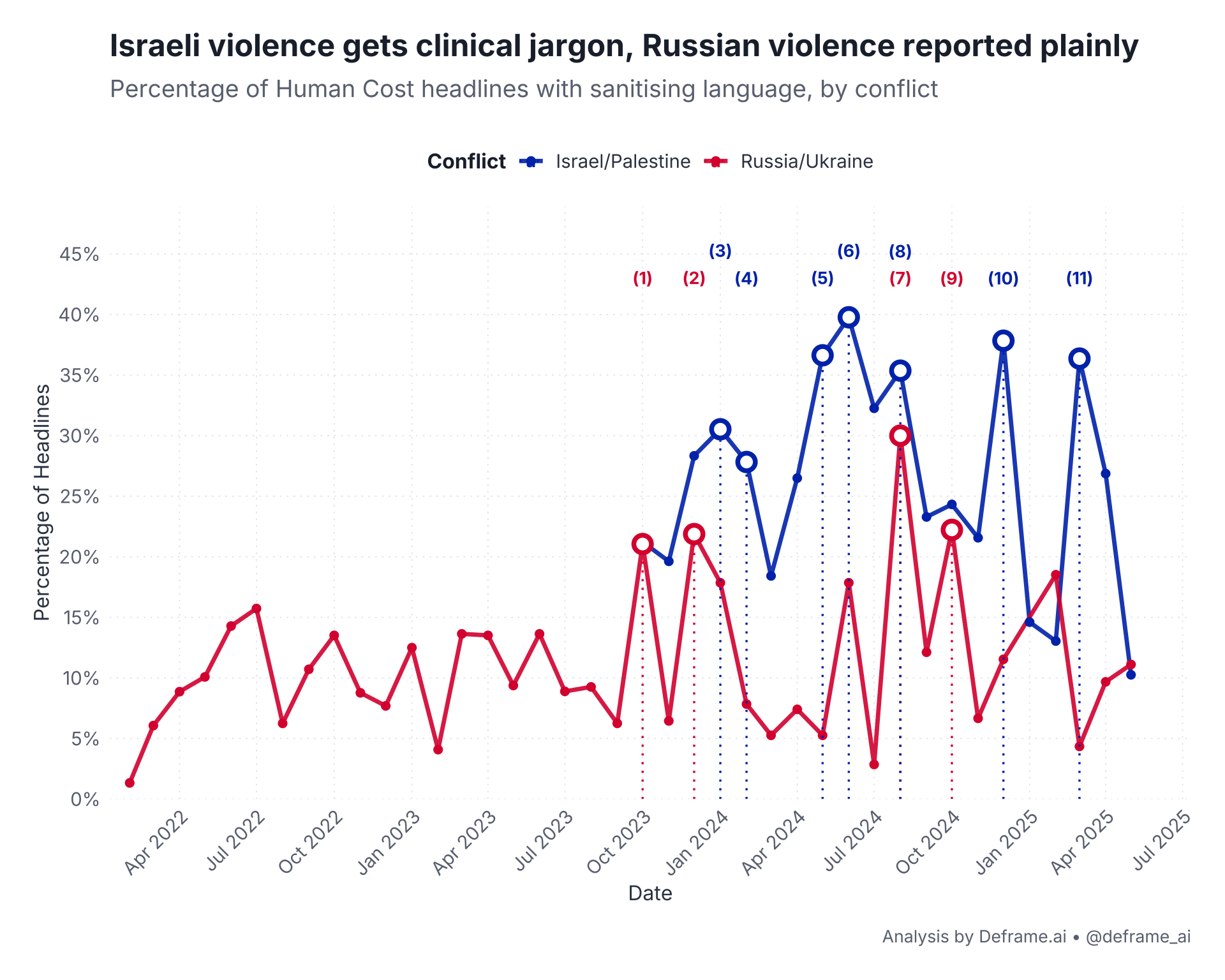
- Ukraine advances in southern counteroffensive; Russian defensive operations intensify
- Winter offensive preparations; increased missile strikes on Ukrainian infrastructure
- South Africa files genocide case at ICJ; Israel escalates operations in Khan Younis
- Israel kills 112 Palestinians in Flour Massacre; Rafah invasion preparations intensify
- Rafah offensive begins; Israel seizes Rafah crossing despite ICJ orders
- Continued Rafah operations; humanitarian crisis deepens
- Ukraine’s surprise Kursk incursion into Russian territory begins
- Renewed Israeli aggression on Gaza City and Khan Younis; ceasefire negotiations stall
- Russia intensifies attacks on Ukrainian energy infrastructure ahead of winter
- Intense Israeli bombardment before ceasefire negotiations; Gaza death toll exceeds 45 thousand
- Ceasefire collapses or major violations; hostilities resume
To quantify how outlets use clinical, technical, or euphemistic language to mask the violent reality of actions, we measured the proportion of headlines employing sanitising language when describing harmful events:
\[R_{\text{sanitizing}}(A) = \frac{|H_A^{\text{sanitized}}|}{|H_A^{\text{sanitized}} + H_A^{\text{direct}}|} \times 100\%\]
Where \(A\) = actor (Israel, Russia, Palestine, Ukraine), \(H_A^{\text{sanitized}}\) = headlines using euphemisms, clinical terminology, or abstract language that obscures violence or harm, and \(H_A^{\text{direct}}\) = headlines using plain language that clearly conveys the violent or harmful nature of actions.
This metric reveals how systematically outlets soften the emotional and moral impact of violence through linguistic distance. Higher sanitizing rates indicate greater use of euphemistic language that creates psychological distance from human suffering.
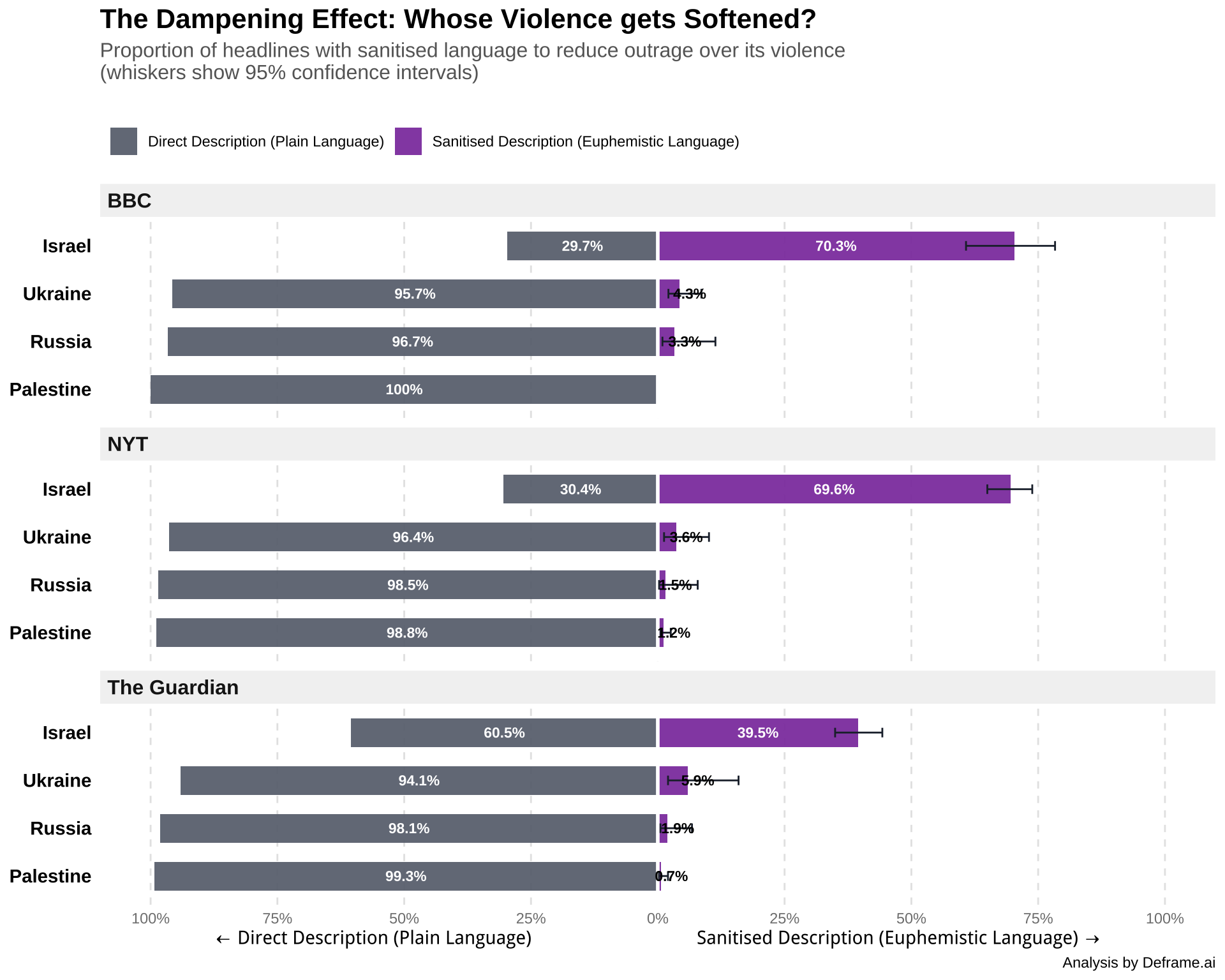
- Across all three outlets, Israeli military actions are consistently described through sanitizing language that obscures violent reality (BBC: 70%; NYT: 70%; Guardian: 40%)
- Between four in ten and seven in ten headlines about Israeli actions employ euphemistic terminology (“operation,” “response,” “targeted action”) rather than direct language (“bombing,” “killing,” “attacking”)
- The same outlets describe Russian actions with plain, unvarnished language (BBC: 97% direct; NYT: 98% direct; Guardian: 98% direct)
💡 Key Takeaway
Sanitizing language reveals itself not as technical precision appropriate to military reporting, but as a selectively deployed euphemistic mechanism that manufactures psychological distance from violence.
When outlets describe Russian airstrikes with direct language like “bombs,” “kills,” and “attacks” while framing Israeli airstrikes through clinical abstractions like “operations,” “responses,” and “targeted actions” 70% of the time, the pattern indicates that euphemistic framing operates as a function of geopolitical alignment rather than event characteristics.
The same categories of violence (e.g., airstrikes causing mass civilian casualties) that receive unvarnished language for one agent are systematically sanitized for another, producing fundamentally asymmetric emotional and moral responses to identical acts of warfare.
5.4 Empathetic narratives: Building human connections with the oppressed
Empathetic narrative framing is not a bias but a humanising technique: headlines that foreground individual stories activate reader empathy in ways that aggregate statistics cannot. This is legitimate and often essential journalism.
The analytical concern is not the technique itself but its distribution. When certain populations are consistently individualised and humanised while others are reduced to anonymous casualty figures, the selective application of empathy becomes a form of editorial hierarchy, determining whose suffering registers as fully human.
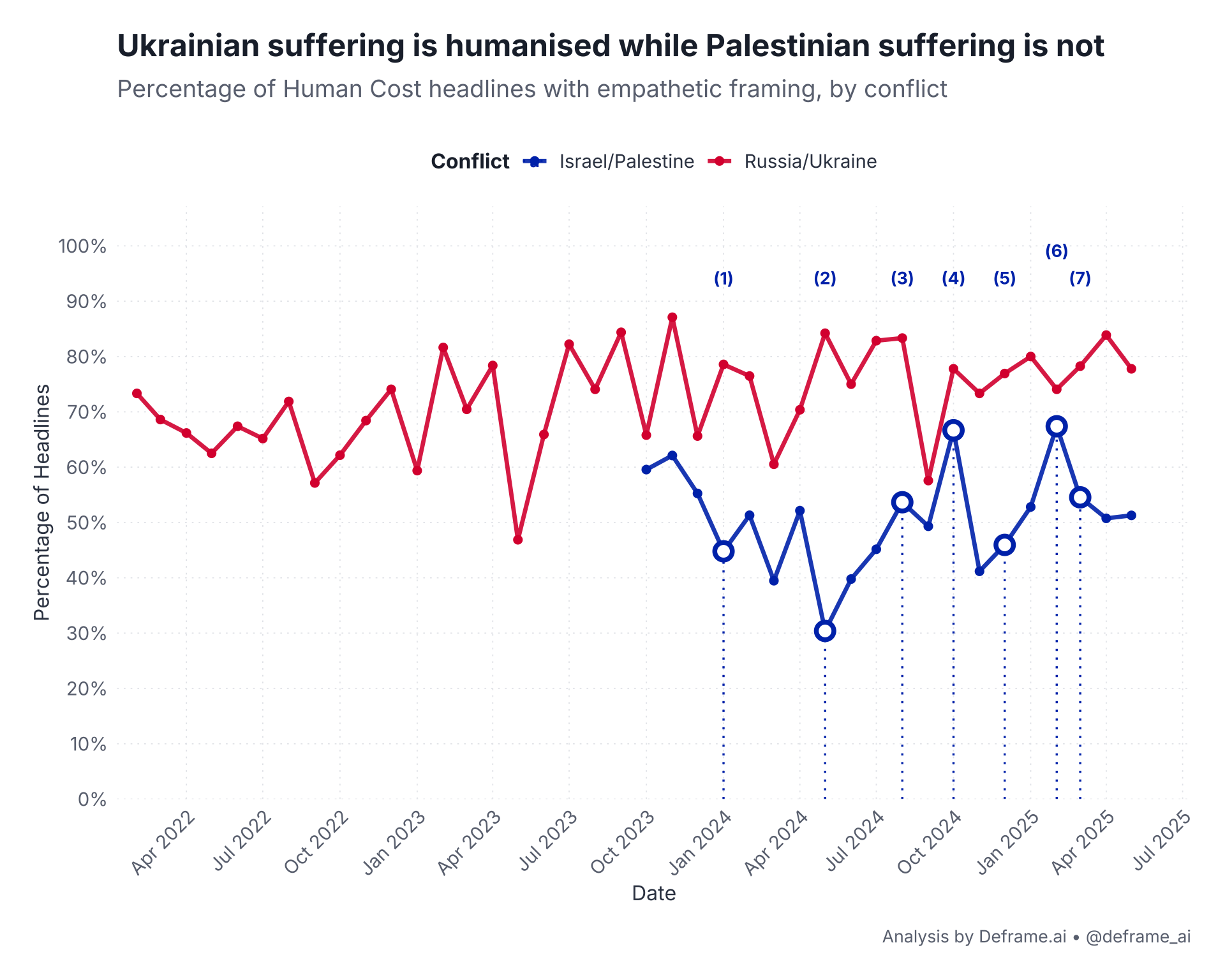
- South Africa files genocide case at ICJ; Israel escalates attacks in Khan Younis
- Rafah offensive begins; Israel seizes Rafah crossing despite ICJ orders
- Renewed Israeli attacks on Gaza City and Khan Younis; ceasefire negotiations stall
- One-year anniversary of Israeli genocide; Israel escalates attacks on Lebanon
- Intense Israeli bombardment before ceasefire negotiations; Gaza death toll exceeds 45 thousand
- Ceasefire complications; tensions over implementation and hostage releases
- Ceasefire collapses/major violations; Israeli hostilities resume
To quantify which victims receive empathetic, humanizing coverage that centers their suffering and experiences, we measured the proportion of headlines employing empathetic narrative framing:
\[R_{\text{empathetic}}(V) = \frac{|H_V^{\text{empathetic}}|}{|H_V^{\text{empathetic}} + H_V^{\text{clinical}}|} \times 100\%\]
Where \(V\) = victim group (Palestine, Ukraine, Israel, Russia), \(H_V^{\text{empathetic}}\) = headlines using humanizing language that centers victim suffering, personal stories, emotional impact, or lived experiences, and \(H_V^{\text{clinical}}\) = headlines not using any empathetic framing (e.g., abstract, statistical, or emotionally distant language).
This metric reveals which victims are portrayed as fully human subjects worthy of empathy versus which are reduced to statistics or abstract casualties. Higher empathetic framing rates indicate systematic humanization through victim-centered storytelling.
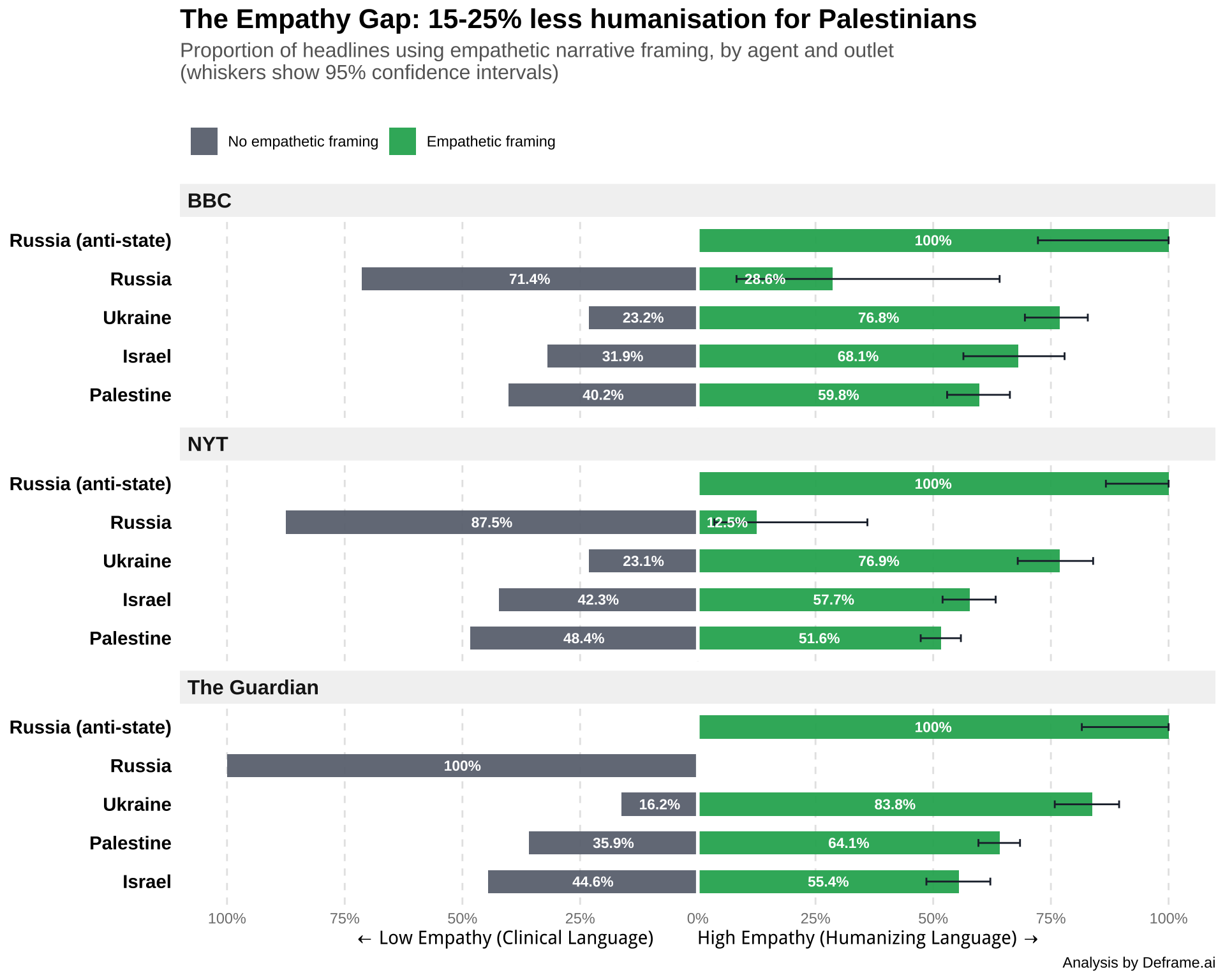
- Russian anti-state voices receive universal humanization (100% empathetic framing across all outlets), followed closely by Ukrainian victims (BBC: 77%; Guardian: 84%; NYT: 77%)
- Palestinian victims receive systematically lower empathetic framing (BBC: 60%; Guardian: 64%; NYT: 52%), representing 1.3-1.5x less humanization than Ukrainian victims despite comparable civilian casualties
- Israel receives nearly identical humanization to Palestine (BBC: 68%; Guardian: 55%; NYT: 58%) despite its role as perpetrator inflicting casualties at a 20:1 ratio and facing credible accusations of genocide
- This creates a fundamental asymmetry: the militarily dominant actor causing mass civilian death receives equal or greater empathetic framing than its victims
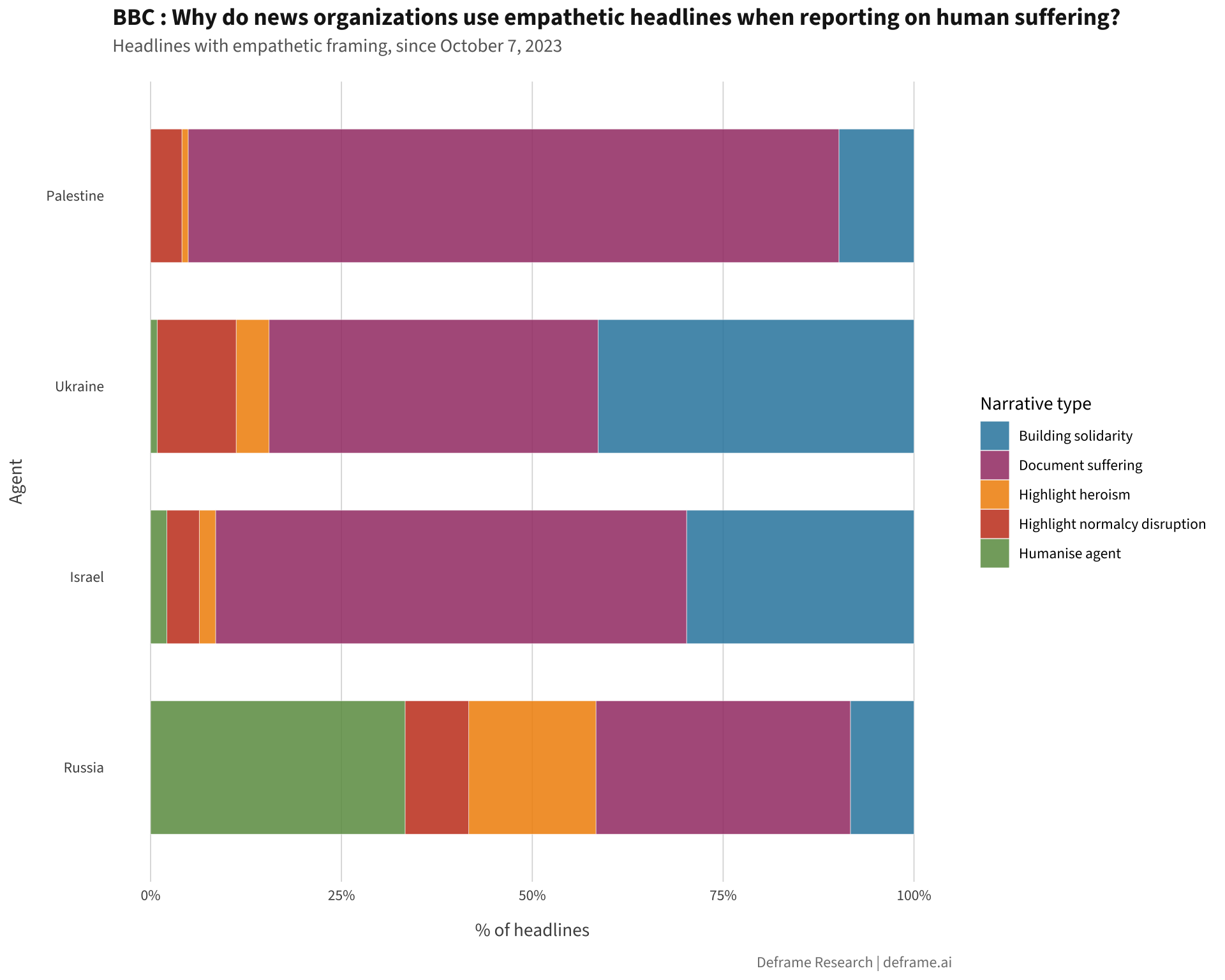
- The BBC uses empathetic narrative framing to build solidarity primarily with Ukraine and Israel
- For Palestine, the BBC focuses on documenting suffering of Palestinians, but at the expense of building any solidarity or humanising them
- In contrast, with Russia, the dynamics are varied as the BBC highlights heroism of Russian opposition (to Putin), humanises these opposition figures, and documents suffering due to Putin’s actions
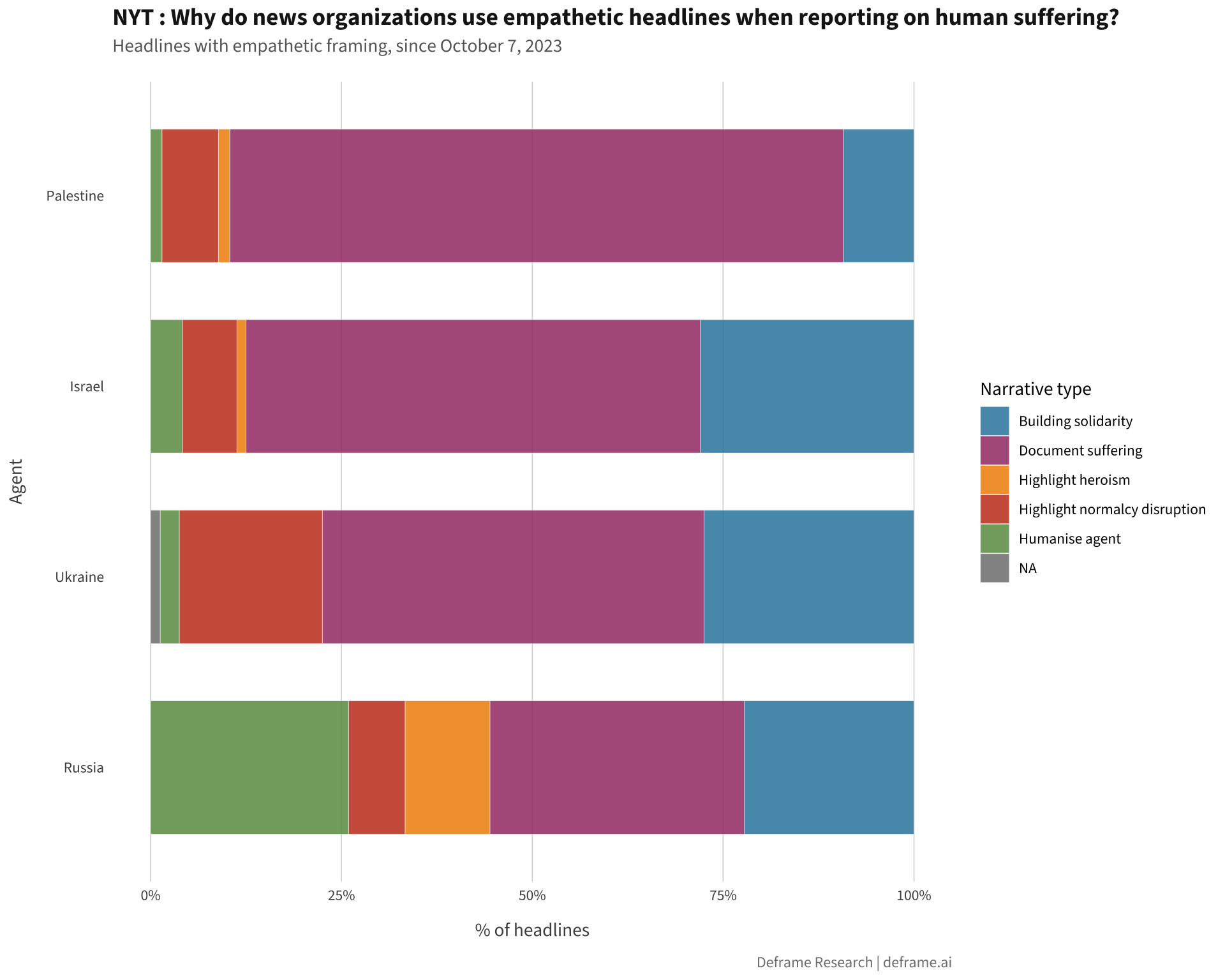
- The NYT headlines build solidarity with Ukraine and Israel in almost equal measure
- In addition, NYT also uses headlines to document suffering for Israelis more than Ukrainians
- For Palestine, focus remains more on suffering documentation but overall least focus on building solidarity with the victims (compared to Israel, Ukraine, and Russia)
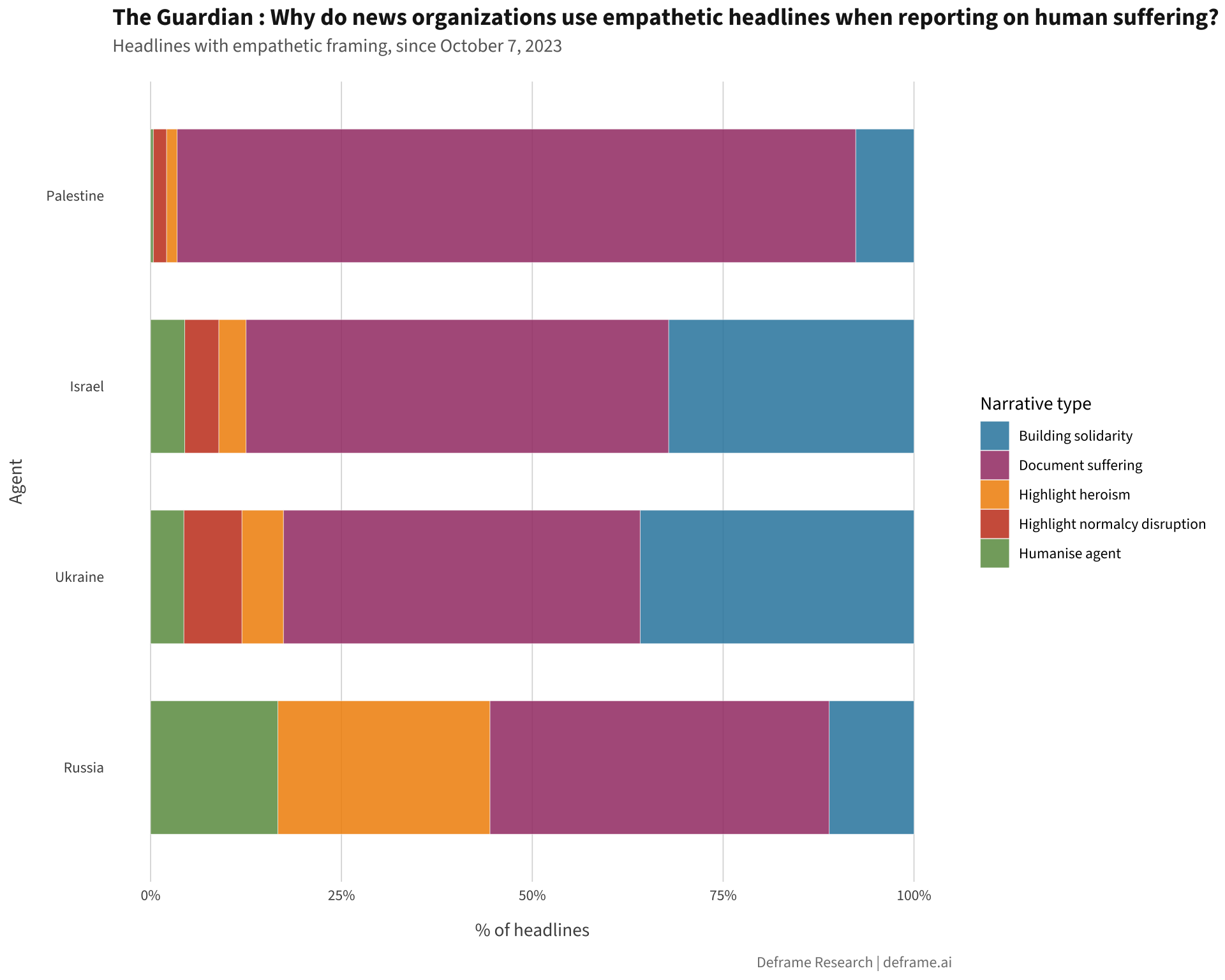
- The Guardian’s headlines build solidarity with Ukraine and Israel, with more focus given to Israel in documenting suffering of Israelis
- Russian coverage focuses on highlighting heroism of opposition figures, whilst also documenting suffering of Russians due to Putin’s push for war
- Palestine coverage emphasises documentation of suffering due to Israeli genocide. However, focus on building solidarity remains dreadfully low compared to Israel and Ukraine
💡 Key Takeaway
Empathetic narrative framing reveals itself not as a neutral journalistic practice of humanizing all suffering equally, but as a selectively deployed mechanism that privileges Western-aligned victims while maintaining emotional distance from adversary populations.
When outlets humanise Ukrainian suffering through personal stories, emotional impact, and lived experiences 79% of the time while providing the same treatment to Palestinian suffering only 59% of the time — despite the latter enduring more civilian casualties, displacement, and infrastructure destruction — the pattern indicates that victim humanization operates as a function of geopolitical alignment rather than humanitarian need.
The near-parity between Israeli empathetic framing (60%) and Palestinian framing (59%), despite radically asymmetric power dynamics and casualty ratios, further demonstrates that empathy is distributed based on political proximity to Western interests rather than proportionate to actual suffering. Coverage systematically elevates some victims to full human subjects worthy of emotional engagement while reducing others to more abstract casualties, shaping public empathy and moral concern through narrative choices alone.
6 Conclusion: The architecture of manufactured apathy
This is not a story of isolated editorial lapses. It is an architecture of interlocking linguistic mechanisms that, with each headline, construct a world in which Palestinian death simply does not register the way other death does. The same three newsrooms, covering the same category of event, the killing of civilians, produce opposite linguistic outputs depending on who is doing the killing and who is dying.
The four mechanisms compound one another:
- Agent deletion erases the killer from the headline, preventing accountability from ever forming in the reader’s mind
- Distancing language converts verified massacres into contested claims, suppressing the moral certainty that would demand action
- Sanitising language wraps bombings in clinical jargon like “operations” and “responses,” dampening the outrage that plain language would provoke
- Selective empathy determines whose children are mourned and whose are counted, shaping which victims the reader is moved to care about
The result is not mere bias. It is the manufacture of apathy at industrial scale, shaping public opinion, constraining political will, and ultimately determining whether populations mobilise to stop a genocide or shrug and scroll past it.
6.1 Future directions
- Three additional coverage clusters remain for analysis: fighting and military operations, diplomacy and politics, and ripple effects, each presenting distinct mechanisms such as false equivalence in fighting coverage and nominalisation in diplomatic coverage
- We are developing specialised, fine-tuned language models for headline bias detection, contributing open-source tooling that researchers, journalists, and civil society can deploy independently
- These numbers are a baseline. What matters next is whether they change, and sustained monitoring, enabled by the tools we are building, will ensure the world is watching
7 About Deframe
This research was conducted by Deframe, an initiative dedicated to exposing systematic linguistic bias in news media through computational analysis and public education.
Our Mission
Deframe arms citizens with the tools to resist manufactured consent by revealing how news headlines systematically frame narratives to shape public perception. We believe that cognitive sovereignty is essential to democratic discourse. Rather than debating whether sources are “biased” or “trustworthy,” we focus on exposing the linguistic techniques themselves, such as agent deletion and sanitizing language, enabling readers to see how framing operates regardless of source.
The Reveal Tool
Our public-facing tool at deframe.ai allows anyone to analyze individual headlines for linguistic bias. Simply paste any headline into our Reveal interface to:
- Identify which bias techniques are present
- Understand how each technique shapes perception
- See a “deframed” version that makes agency and responsibility explicit
Get Involved
- Use the Reveal tool: deframe.ai
- Access our research: research.deframe.ai
- Join the movement: Follow our ongoing analysis of media framing patterns
Contact & Feedback
We welcome critical engagement with our findings and methodology. For questions about methodology, access to raw data, or collaboration inquiries:
- Website: deframe.ai
- Research Portal: research.deframe.ai
- Email: ali@deframe.ai